







Sept. 15, 2006
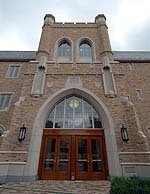
A new era in science education at Notre Dame is dawning this fall with the opening of the Jordan Hall of Science, a building that contains the most advanced scientific and educational teaching instrumentation of any university facility in the nation.
The $70 million, 201,782-square-foot structure on Juniper Road is the largest building devoted solely to undergraduate education at the University and stands in marked contrast to other campuses across the country, where science construction often translates solely to new laboratory space and instrumentation for researchers.
“Jordan Hall will dramatically improve the way science is taught at Notre Dame by taking full advantage of the talents and ingenuity of our world-class faculty,” said Joseph P. Marino, dean of the College of Science. “Our students will have the opportunity to use cutting-edge technologies which will enable them to excel in their chosen fields.”
Jordan’s majestic Great Hall features 12 glass-enclosed display cases that houses presentations on a wide variety of scientific topics.
The building includes 40 undergraduate teaching laboratories for instruction in biology, chemistry and physics and two identical 250-seat lecture halls in which faculty can display different images simultaneously on three screens.
An octagonal-shaped, 150-seat multi-media visualization room enables students and the general public to experience images as diverse as Hubble Space Telescope views of the universe and the inside of cell projected on the room’s domed ceiling.
The facility also features an observatory, greenhouse and herbarium.
The move into Jordan Hall unofficially began June 14 when the first of 600,000 animal specimens belonging to the Department of Biological Sciences were transferred across Juniper Road from the Galvin Life Science Center to the new facility. The collection includes 268,000 dried and pressed plant specimens from the Nieuwland Herbarium, developed in 1904 by famed Notre Dame chemist and botanist Rev. Julius A. Nieuwland, C.S.C., who helped perfect synthetic rubber in the 1930s. The oldest specimens were collected in the late 1800s by Nieuwland’s mentor, the pioneering early American botanist Edward Lee Greene, and constitute a national botanical treasure.
The herbarium specimens, as well as 280,000 invertebrates (including 50,000 mosquitoes) and 5,000 vertebrates (chiefly reptiles, amphibians, fishes, birds and mammals) are now properly stored and displayed in Jordan Hall’s Museum of Biodiversity.
The formal dedication of Jordan Hall took place Sept. 14 with ceremonies that included a Mass in Sacred Heart Basilica, a blessing of the building and a reception and tours.
Coinciding with the dedication of Jordan Hall, the second annual Notre Dame Forum, titled “The Global Health Crisis: Forging Solutions, William G. Gilroy
Effecting Change,” was held Sept. 14 in the University’s Joyce Center arena. Moderated by Gwen Ifill, senior correspondent for the NewsHour with Jim Lehrer, the forum’s panelists included economist Jeffrey Sachs, director of the UN Millennium Project, medical anthropologist and physician Dr. Paul Farmer, founder of Partners in Health, and Miriam Laker Opwonya of Uganda, a medical doctor who specializes in tropical medicine and international health issues.
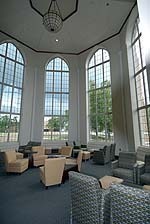
Looking out from one of the reading rooms in the new Jordan Hall science building. Through the windows is the Gate 3 entrance to the Joyce Center.
|
 |
Notre Dame houses a world-renowned Center for Global Health and Infectious Diseases and its new Global Linkages of Biology, the Environment and Society (GLOBES) program enables researchers to use an interdisciplinary approach in seeking solutions to pressing problems in human and global health.
The Notre Dame Forum was established last year by University President Rev. John I. Jenkins, C.S.C., to bring world leaders to campus to discuss their experiences and offer advice to Notre Dame students preparing to enter the public debate and shape the professional world.
In 1988, Notre Dame scientists began outlining their needs to further enhance the University’s notable record of success in science education and Jordan Hall was first envisioned. A leadership gift from John W. “Jay” Jordan, a Notre Dame alumnus and member of the University’s Board of Trustees, led to Board approval for construction of the facility in 2002, and groundbreaking ceremonies were held in October 2003.
Jordan and scores of other benefactors were honored during the Sept. 14 dedication ceremonies. “Jordan Hall provides Notre Dame students with state-of-the-art facilities to explore the natural world — from the molecular network within a cell to the cosmos,” said Dennis C. Jacobs, vice president and associate provost. “In this spectacular learning environment, Notre Dame faculty have the privilege to train the scientific leaders of tomorrow.”