







Sept. 28, 2006
By Lou Somogyi
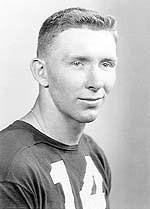
During his years at Notre Dame from 1950-54, multi-purpose extraordinaire John Lattner was enrolled in the Air Force ROTC.
Early in his freshman year in 1950, though, Lattner was informed by head coach Frank Leahy that he should be in another branch of the military. “Ah, Johnny Lattner, you should have been in the Navy – you’re a cruiser!” Leahy would tell him.
The greatest athletes have a tendency to look as if they’re in cruise control, but Leahy’s statement was about maximizing Lattner’s skills with a more passionate effort.
“He used that line quite a bit, especially when I was a freshman,” said Lattner, whose Leahy impersonations could be a road show. “I wasn’t a real fast back. I was a big back for those days, about 195 pounds and close to 6-foot-3…but I thought I was better than a cruiser. I thought I’d be a PT boat, at least.
“My speed wasn’t the best, but most of the time it was because I had no intensity. I had to push myself all the time – and Leahy would help. I had some talent, don’t get me wrong, but I had to keep improving on what I had. I wasn’t gifted with a lot of speed. I could play defense and I had a little strength behind my running…but if I didn’t hit the hole fast enough, or would get tackled from behind, then there was that reaction from Coach that I wasn’t extending myself.”
Of course, the autumn of 1950 was not a pleasant time for Leahy, who had already produced four national titles at Notre Dame and never lost a game from 1946-49. But the recruiting gravy train ended in the late 1940s, injuries arose…and all of a sudden the Irish finished 4-4-1 in 1950. A product of Chicago’s Fenwick High School, Lattner was the rock upon whom Leahy would return Notre Dame to glory. The Irish head coach assembled excellent recruiting classes in 1950 and 1951 that would propel three consecutive Top 4 finishes from 1952-54, with Lattner, a two-time consensus All-American and the 1953 Heisman Trophy winner, serving as the crown jewel.
Lattner averaged an astonishing 18 yards per carry as a senior at Fenwick High, but due to NCAA freshman ineligibility back then, he couldn’t join the Notre Dame varsity until 1951. With the United States embroiled in the Korean War at the time, freshmen were made eligible in 1951, and the genesis of one of the great backfields in Notre Dame annals was borne.
Freshman quarterback Ralph Guglielmi started in the 19-12 victory at USC to conclude the 1951 rebuilding year (7-2-1 record), would be the third pick in the 1955 NFL Draft, and is enshrined in the College Football Hall of Fame.
Sophomore fullback Neil Worden, Lattner’s classmate, would be the No. 9 pick in the 1954 NFL Draft and actually finished with more yards rushing at Notre Dame (2,039) and more touchdowns (29) than Lattner (1,724 and 27, respectively).
Freshman Joe Heap, a three-time Academic All-American, was the No. 8 pick in the 1955 NFL Draft and became the first Irish player to eclipse 1,000 yards receiving and 1,000 yards rushing in his career. The only other player to do so since then is Raghib “Rocket” Ismail.
Yet Lattner, the No. 7 pick in the 1954 NFL Draft, was the centerpiece. He wasn’t as swift as Heap, as powerful as Worden or as bold as Guglielmi…but there wasn’t a better all-around player in the nation, never mind at Notre Dame during his college career.
These days, a triple-threat player is defined as a runner, receiver and return man. In Lattner’s day, it was about playing offense, defense and special teams.
In 1952, the year Notre Dame defeated four different conference champions or co-champs – Texas, Oklahoma, Purdue and USC, and tied Ivy League champion Penn – Lattner was the lone Irish player to start on both offense and defense. Plus, he was the punter and return man.
One year later as a senior, Lattner didn’t lead the unbeaten Irish (9-0-1) in rushing, receiving, interceptions, tackles or touchdowns, but he still won the Heisman for his body of work.
A demon on defense, Lattner set the career interceptions record (13) at Notre Dame, could run inside or outside on offense, completed four passes for 111 yards, averaged nearly 16 yards per catch during his career, returned two of the eight kicks booted to him as a senior for TDs, averaged about 11 yards per punt return during his career and handled the punting.
Like John Lujack before him and Paul Hornung after him, Lattner was the consummate “triple threat” – and then some.
He also had a propensity for playing his best when the stage was the brightest. In the 1953 opener at Oklahoma, his interception sealed a 28-21 Irish victory – the last time the Sooners would lose until four years later, also to Notre Dame. In a hard-fought 28-20 win at Penn, Lattner returned a kickoff for a 92-yard score to tie the game. At arch rival USC, he carried 17 times for 157 yards and four touchdowns.
In between, he scored the clinching TD in a 27-14 win over Georgia Tech to end the Yellow Jackets’ 31-game unbeaten streak. Against teams from every corner of the country, Lattner thrived – and that’s how he won what remains the second closest Heisman race in history.
“I actually lost the Midwest to (runnerup) Paul Giel of Minnesota,” Lattner said. ” I won the East Coast vote because I had a good game against Pennsylvania, and I won the West Coast because I scored four touchdowns against Southern Cal. Television really wasn’t a big impact back then. The publicity had to come from playing in areas where you could get the media’s attention from all over the country.”
Alas, because of a controversial 14-14 tie with Iowa, the Irish finished No. 2 in 1953 to unbeaten Maryland. The Terrapins lost to Oklahoma – where the Irish won in the opener – in the Orange Bowl, but back then the final polls were completed after the regular season. “You sucked it up a little bit because there wasn’t anything you could do about it,” Lattner said. “There were five polls back then and we won three of them, but the only two that counted were the UP and AP.”
After his graduation, Lattner played with the Pittsburgh Steelers and finished third in the Rookie of the Year balloting. However, because of his ROTC commitment, he had to be with the Air Force the next two years, where he suffered a football career-ending knee injury while playing at one of the bases.
He might have been a cruiser early in his career, but John Lattner ultimately became the aircraft carrier for Notre Dame’s football program in the early 1950s.
Lou Somogyi is editor of Blue & Gold Illustrated
John Lattner By The Numbers
1 Player in college football history – Lattner – who has won the Maxwell Award twice. Lattner won the honor, presented annually since 1937 to the nation’s top player, in 1952 and 1953. Other Notre Dame recipients were Leon Hart (1949), Jim Lynch (1966) and Ross Browner (1977).
2 Different Heisman Trophies owned by Lattner. His first was destroyed in a 1968 fire at a Chicago restaurant he owned with a partner. It was replaced with a new one, courtesy of the Downtown Athletic Club in New York City.
9 Seconds left in overtime when Lattner scored the game-winning basket in Notre Dame’s 75-74 victory over No. 18-ranked NYU in Madison Square Garden on Feb. 25, 1952. With three top Irish players declared academically ineligible in the second semester Lattner joined the hoop squad to help out as a reserve.
9-1-2 Notre Dame’s record against ranked opponents in Lattner’s last two seasons, as the Irish finished No. 3 in 1952 and No. 2 in 1953. Since then, Notre Dame had back-to-back Top 3 finishes only one other time: 1988 (No. 1) and 1989 (No. 2).
13 Interceptions recorded by Lattner during his Notre Dame career. It was a school record until 1963, when Tom MacDonald finished with 15. The only other Notre Dame player to record more was Luther Bradley with 17.
16 Notre Dame players in history who were twice named consensus All-Americans. Lattner is the last Irish running back to achieve that feat (1952-53), although the recognition was earned just as much for his play on defense and special teams.
21 Years old Lattner turned on Oct. 24, 1953, when the Notre Dame student body serenaded him with “Happy Birthday” before he scored the final touchdown in a 27-14 victory over Georgia Tech, snapping the Yellow Jackets’ 31-game unbeaten streak.
26 Seasons Lattner held Notre Dame’s career all-purpose yardage (rushing, returning and returns) total before Vagas Ferguson finally eclipsed it in 1979. Lattner rushed for 1,724 yards, caught 39 passes for 613 yards and had 673 yards in returns for a total of 3,010.
40.1 Yards averaged by Lattner on only eight kickoff returns as a senior. Two of his returns resulted in touchdowns, 86 yards versus Purdue and 92 yards against Penn, breaking several would-be tackles along the way.
56 Points that separated Heisman Trophy winner Lattner (1,850) from runner-up Paul Giel (1,794) of the University of Minnesota in the 1953 balloting. It was the closest finish in history until 1985, when Bo Jackson (1,509) edged Chuck Long (1,464) by 45 points.
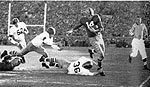
John Lattner held Notre Dame’s career all-purpose yardage (rushing, receiving and returns for 26 years until Vagas Ferguson eclipsed the mark in 1979. Lattner rushed for 1,724 yards, caught 39 passes for 613 yards and had 673 return yards for a total of 3,010 for his career.
|
 |
10 Questions With John Lattner
Ask lifetime Chicago native and resident John Lattner about his greatest achievement and he’ll point to his eight children and 25 grandchildren for he and his wife, Peggy. All of them were scheduled to be in attendance for this afternoon’s game against the Purdue Boilermakers.
But there were other memorable days at Notre Dame as well for the typically amiable Lattner.
Q: How did your introduction to Notre Dame occur?
JL: I was taught by the Sisters of Mercy nuns in Chicago. Where we lived, on the West Side, there were a lot of Notre Dame people. At the time, I don’t think I even knew how to walk, but I already knew Notre Dame was the epitome. I had 90 scholarship offers, but this was 1950 when Notre Dame had just completed a fourth straight unbeaten season. People were saying, “Don’t go to Notre Dame, because you’ll just be a number there. You won’t be able to play, you’re not fast enough”…just a lot of negatives, particularly the coaches who were trying to recruit me for their schools.
I knew that at least 40,000 people would come from Chicago to see a Notre Dame game, because this was before television had become big. So I’d be playing in front of my home crowd. It was an added incentive for me to at least try to make the team.
Q: So here you are on the freshman team at Notre Dame and the varsity finishes 4-4-1 in 1950 – which was more losses than the three that Frank Leahy had in his first seven seasons at Notre Dame. How rough must that have been?
JL: Put it this way – we started spring practice for 1951 on Dec. 9, 1950. We had lost a lot of personnel from those teams in the 1940s and lost a lot of people to injuries in the 1950 season. We were practicing from Dec. 9 through Dec. 19, until they let us go home for Christmas. When we came back after Christmas break, we used to have final exams at the end of January, so we didn’t have any practice for about three weeks. Then we came back in February to practice in the Fieldhouse and in the old Navy drill hall. We practiced there until May 14 for the Old-Timers game.
Q: Any other stories on how obsessed Frank Leahy was with winning and getting Notre Dame back to the top?
JL: My dad died in April of my freshman year and he was buried in Evansville, Ind., where he was from. We came out of the church with the casket and Coach was there with the assistants, Bernie Crimmins, Bill Earley, Bob McBride…Coach came up to me and said, “John, I’m awfully sorry about your father…do you have any way back to school?” He wanted me to make it back there for practice. He didn’t miss a cue. We practiced a lot that spring. It paid off because we were a real young team but improved a lot the next year.
Q: You had a memorable birthday in your senior year (1953) when you ended Georgia Tech’s 31-game winning streak but also saw Leahy collapse on that same day outside the locker room and nearly die. The word was you thought he was faking it. Is that accurate?
JL: My good friend from high school was Bobby Rigali. His dad, Joe, played for Rockne and he was on the national title team with The Four Horsemen. He used to tell us about some of Rockne’s halftime stories. Bobby would scrimmage and was a tough kid, but because he didn’t play he was a little disgusted with Leahy. So we were sitting next to each other in the locker room at halftime and we saw Father Hesburgh go into the training room where Leahy was, Father Joyce, the trainer Gene Paszkiet, and Danny Penza, our captain…so we knew something was going on. Anyway, Penza comes out and he was crying and said, `The Coach is dying, he’s dying!’ Rigali gives me a nudge and says, “Don’t believe him. He’s pulling a Rockne.”
Q: The score was tied in the second half, and even though you found out that Leahy was in serious condition, how did you find the resolve to win?
JL: It’s something that Leahy taught us to fight through. You have to concentrate completely on the game and move forward. If you think about your mistakes, you’re going to make more mistakes. We knew he was sick, but we still had to go on and beat a real good team. There were no thoughts of how bad off he was – because that’s how he wanted us thinking.
Q: How did you find out you won the Heisman and what do you remember the most about it?
JL: (Athletics director) Moose Krause called me and that’s how I found out. He said, “We’re going to New York and you can invite your best girlfriend!” Well, I wasn’t dating my wife at the time so I took my mother. It was a wonderful experience for her. She had never flown and never been in New York. The night before the presentation they took us for a night out on the town and at 2 a.m. my mother and I ended up in the Copacabana in Times Square. My mother loved her martinis, and one of the people with us said, “Johnny, tomorrow’s going to be a long day. We better be heading back.” I said, “Well, go talk to my mother.” So he explains to her that tomorrow will be a busy day and she says, “Oh, okay, instead of a martini I’ll have a Miller High Life then.” We stayed until 3 a.m. She wasn’t stiff or anything, but she just enjoyed the dancing and was going to have a good time.
Q: Although you didn’t have a girlfriend to take to the Heisman dinner, you did spend some time with Marilyn Monroe when the team went to play USC in Los Angeles during your sophomore year (1951)? Can you relay the experience?
JL: There was a film called “Clash by Night” she was doing at the time at a Los Angeles studio, so after practice about five us went over to the studio unannounced. We didn’t have carte blanche to go there but Bobby Joseph, our extra point kicker, could talk like a million dollars. He talked his way into us getting on the set. Marilyn wasn’t doing anything that morning, so we went back to practice at one of the big hotel dining hall rooms and afterward we went back to the studio and sat with her in her star hut for at least an hour. We told her we’d get her a field pass, so then she brought out her publicity pictures for us. She said, `What should I put on it?’ I said, “Dear John, thank you for the wonderful night we had together. Love and kisses, Marilyn.” She signed it just like that and put her phone number on it.
Later we called her up that night and said, “Marilyn, we’re all set with the field pass!” She said, “John, I’d love to go but I have to pick up another athlete at the airport.” You know who the other athlete was? Joe DiMaggio.
She drove us back to our hotel from the studio. There were five of us in that little car but we had a ball. She was so delightful. I had a buddy in the Marine Corps who was waiting for me at the hotel. She then drove him back to the main base. What a gal!
Q: What happened to the photo?
JL: I lost it in a flood in the basement back in Chicago. I didn’t have it up on the wall but I should have. We had a flood that went over where I had it stored. It was no big deal. I had it hanging on my dorm wall in Morrissey Hall but the rector made me take it down. He kept it and said, “You can get it back when you leave this dorm.” So at the end of my sophomore year I got the picture back. Things were more strict back then, but at least he didn’t kick me out of the dorm.
Q: Who’s the greatest Notre Dame player you’ve ever seen?
JL: I never saw Angelo Bertelli play but I loved him as a man. John Lujack was a fantastic defensive and offensive player…and Paul Hornung. Paul was a freshman when I was a senior but you could see even then what a special talent he was. I’d be a punter for the varsity and he’d come down from the freshman team and kick with me and I’d say, “Paul, go back to the freshman team, you’re making me look bad here!” What struck you about him was that he was so a real big back for those days, about 220 pounds, but so athletic.
He also had a car when he was a freshman and I didn’t as a senior. I was supposed to be like a big brother and watch over him, so before school started I said to him one time, “Let’s go to a movie!” He didn’t want to and took me to Mishawaka and some bars I never heard of. We had only a couple of beers, but after a couple of days with him I said, “Paul, if I stay with you, I won’t make the team.”
Q: You’ve always been known as very down-to-earth and humble. Where did that come from?
JL: I never expected anything. My ambition in high school was to maybe get a scholarship to a small school like Loras College or St. Benedict. To get a chance to go to Notre Dame…I didn’t think I had all this in me, to be frank. I’m surprised I’ve had all these accolades thrown this way.
Lou Somogyi is the editor of Blue & Gold Illustrated
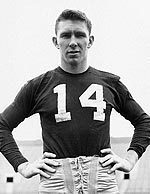
During his career, John Lattner was known as much for his defensive talents as his offensive prowess. He held the Notre Dame record for interceptions with 13 until 1963 when Tom MacDonald finished with 15. The only other Notre Dame player to record more was Luther Bradley with 17.
|
|
Fumble Recovery
By Lou Somogyi
Most Heisman Trophy winners usually have a defining game or play. For Notre Dame’s Tim Brown, it was his back-to-back punt returns for touchdowns against Michigan State in 1987. For Boston College quarterback Doug Flutie it was “The Hail Mary Pass” at Miami in 1984. Yet for 1953 Notre Dame Heisman Trophy winner John Lattner, maybe the most talked about game in his career is the one at Purdue in his junior year (1952).That was the game where Lattner fumbled five times – yet he doesn’t mind rehashing the details.
“It’s the only record I have left at Notre Dame,” laughs Lattner. The game has become somewhat of an urban legend around campus, but some fiction also has been involved.
Fiction: Lujack’s fumbles cost the Irish the game. In fact, the unranked Irish upset No. 9 Purdue, 26-14 at West Lafayette.
In one of the most bizarre games Notre Dame ever played in, the Irish fumbled a school-record 10 times – but Purdue coughed up the ball 11 times. Notre Dame ended up recovering 15 of those 21 miscues, including a touchdown by Irish right tackle Joe Bush of a Lattner fumble in the end zone.
In that same game, Lattner snared a 47-yard touchdown pass from Ralph Guglielmi on the last play of the first half to give the Irish a 20-7 lead. Even after a solid victory against a Top 10 foe, though, Lattner may have made his best move once he got off the field.
“I didn’t go back on the train with the team because I figured Coach Leahy was going to throw me off of it,” Lattner said. “My brother drove me back to Chicago, but that wasn’t too unusual because if we had a game nearby, we’d drive back to Chicago for the weekend and report for classes on Monday.”
In the team meeting that Monday, Leahy talked to the team about a certain back who was “a traitor to Our Lady’s school because of five fumbles.” “I was ready to take off like a bandit after the meeting when I heard Leahy say, `Ah, Mr. Lattner, I’d like to have a little chat with you.’ He said, `John, I have not been able to prepare for the upcoming game because of your fumblitis. Why would a boy of your caliber fumble five times?’ I told him I couldn’t explain it.
“He said, `Ah, John, back in Chicago, do you have any girl problems that would cause you to fumble five times?’ “
That wasn’t it.
“Then he said, `When you were in Fenwick High School in Chicago, did you ever go to the racetrack with your dad?’ He must have known I did because I did like to play the horses with my dad on Saturday mornings. “When I said I did place an occasion bet he said, `John, last Saturday, did you have a wager with the bookies on the West Side?’ He thought I was betting on losing – but we ended up winning by a pretty decent margin against a team ranked ahead of us.”
Satisfied that the problems weren’t mental or a lack of scruples, Leahy handed Lattner a football and ordered him to carry it with him at all times.
“He said, `If I see you around campus without this football, you’ll lose your scholarship here at Notre Dame,’ ” Lattner said. “One of my teammates put a handle on the football to make it a little easier to carry around. I did that for a whole week. I went to classes with it, slept with it…I did everything he wanted me to do. I didn’t get a lot of snickers from the fellow students, but the professors thought it was pretty cute.
“I carried it all week because I truly thought I might lose my scholarship. Leahy was a man of his word. I just put my hand on the handle and carried my books.”
Fiction: It didn’t solve all the fumbling problems (the Irish lost a record seven fumbles in a 21-3 loss later that year to Michigan State), but eventually the fundamentals improved.
“I might have fumbled once my senior year,” Lattner recalled.
Fact: To err is human. To get a handle on it and still become the nation’s most esteemed football player is divine.