
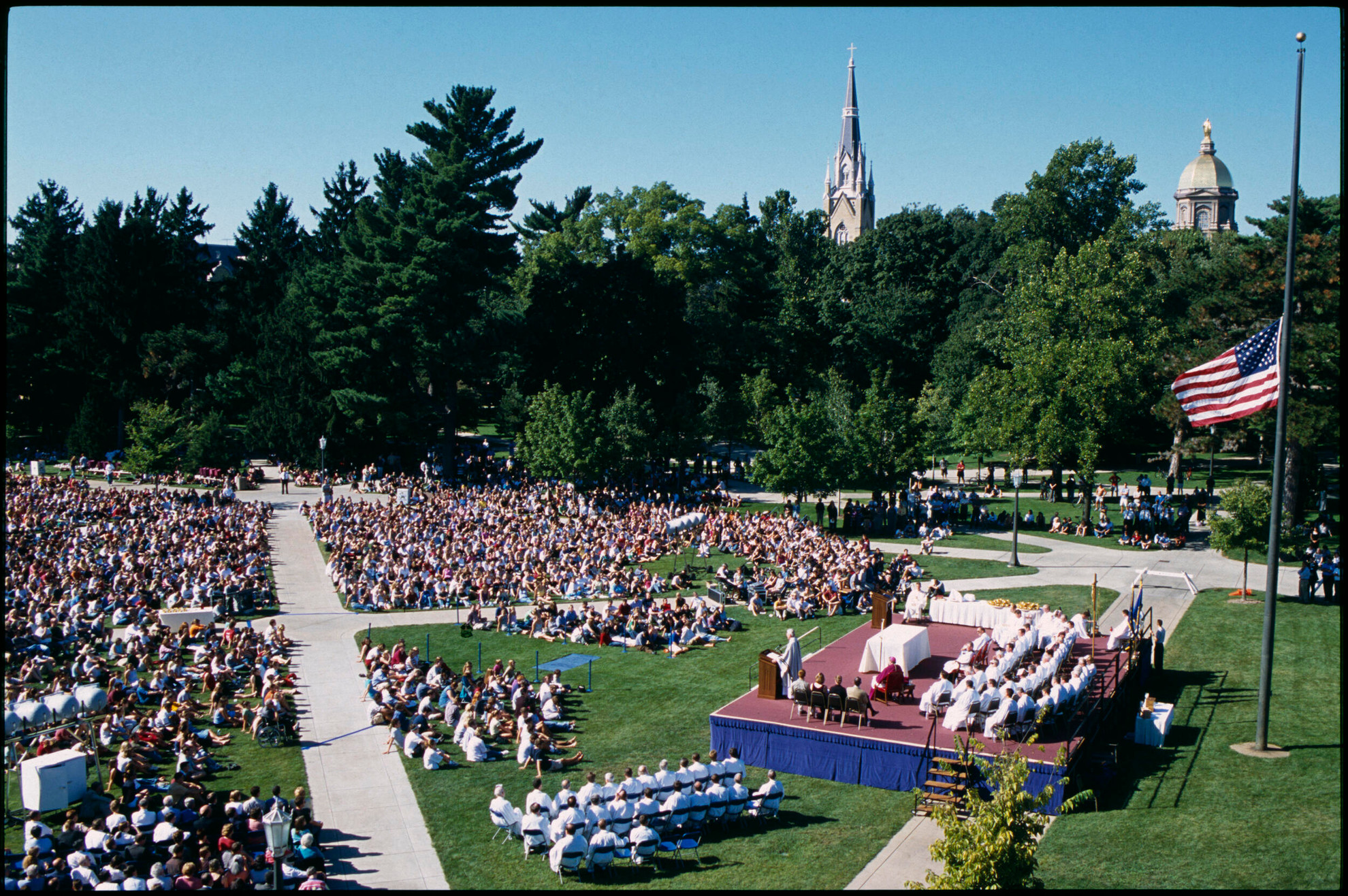
Editor’s note: The following is a feature that appeared in Notre Dame Magazine in the winter of 2001-02 that provides a comprehensive review of how the University of Notre Dame’s campus, students, visitors and scholars reacted to the events from September 11, 2001. The Notre Dame – Toledo football contest marks the 20th anniversary of the attacks and provides an opportunity for reflection and remembrance of events that still resonate throughout our society, campus and community to this day.
A giant hook and ladder truck from the South Bend Fire Department stood on the Main Quad in front of Walsh Hall and Sorin College. Parked nearby were an engine from the campus fire department and various other rescue vehicles. No sirens whooped in the twilight of an overcast fall day, though. The dominant sound was the pealing of bells from the Basilica of the Sacred Heart. There was no fire, either. And no firefighters to be seen.
They were all inside the church.
It was October 11, a month from the day of terrorist airliner crashes in New York City, at the Pentagon and in western Pennsylvania, and the University was holding a special Blue Mass to honor and ask God’s blessing on local public safety personnel along with the hundreds who perished in the rescue efforts in New York City.
Inside the church a white firefighter’s helmet rested in front of the altar between depictions of Saint Florian, patron of firefighters, and Saint Michael the Archangel, patron of police officers. Nearby stood a wreath that read “Pray for Peace and Reconciliation.” In the front pews in uniform sat the 11 special guests: three firefighters and eight police officers from an engine company and precinct at Ground Zero.
The old stereotype of the Irish cop pounding the beat in Gotham must still have some substance to it, because the group included a Conway, a Concannon, a McNally and a McGill. At the end of the Mass, police Sergeant Eddie Colton and firefighter John Gilhooly approached the altar for a special presentation. Colton was carrying a box.
In a Brooklyn accent tight with emotion, Colton explained that the box contained an American flag that had flown for two weeks over Ground Zero next to the temporary morgue. Either by chance or divine intent, when the group went to the morgue the day before leaving for Indiana to look for a priest to bless the flag, they had found only one clergyman present. He turned out to be a Notre Dame alum, Father Charles Miller, OFM, ’59.
Handing the flag to the celebrant and homilist of the Mass — President Malloy — Eddie Colton said, “God bless you . . . God bless America.”
The capacity congregation gave him a standing ovation.
The Blue Mass was only one of the many ways the campus community responded publicly to the events of September 11, but it illustrated as well as any the beliefs and culture that define Notre Dame: Roman Catholic and Irish-American; a chapel in every dorm and a football pregame ceremony where lines from the Constitution and Declaration of Independence are recited like a prayer; a university with Army, Navy and Air Force ROTC units, and a substantial portion of the faculty and student body committed to social justice and peace, if not outright pacifism.
In the days and weeks that followed the tragedy, there were Masses and prayer vigils and candlelight processions around campus, the widespread presence of American flags, demonstrations of honor and support for those in uniform — be they cops, firefighters or soldiers. There was letter-writing, praying and leafleting for peace, reconciliation and refugee relief. Early morning workouts by ROTC students on the intramural fields took on a poignancy, at least to civilian observers. Faculty in anthropology, religion, international affairs, law, peace studies and other disciplines fielded calls from reporters and addressed large audiences of students, colleagues and community members at panel discussions. In dining halls, offices, dorm rooms and classrooms, the questions were always the same: Why did this happen? Why do they hate us? What should we do?
There were answers and disagreement, confusion and worry. And, sometimes, new precautions and misunderstandings.
A campus mail carrier refused to pick up a parcel at the Notre Dame post office that had a Chinese return address and was addressed to a Chinese student. Although the box was wrapped in plastic, a white powder could be seen leaking from within. The substance turned out to be laundry detergent.
Airplanes were banished from the skies over Notre Dame stadium during games, and even the Goodyear blimp was ordered to keep its distance.
On a Sunday at the end of September, some 70 Notre Dame Army ROTC students wearing camouflage uniforms with packs and carrying rubber replica M-16s were treated to a helicopter ride back to Notre Dame after enduring training exercises at a facility 20 miles to the west. The chopper landed in a field at Holy Cross College. Traffic was stopped along U.S. 31 Business to permit the soldiers to cross in formation. They then marched through campus, passing the police station and Grotto on their way back to the ROTC’s Pasquerilla Center.
The sight of soldiers dressed for battle and carrying what looked like weapons inspired some observers but alarmed others. The commanders had arranged ahead of time for campus security police to help with the road crossing, but few people outside of security knew what was happening. A University administrator later called the ROTC commanders together and reminded them that maneuvers in such attire were permitted only in designated areas, like a vast parking field bordered by Pendle and Juniper roads.
Such restrictions have existed for years, but some interpreted the action as a hostile gesture toward the ROTC by supposedly anti-military elements within the administration.