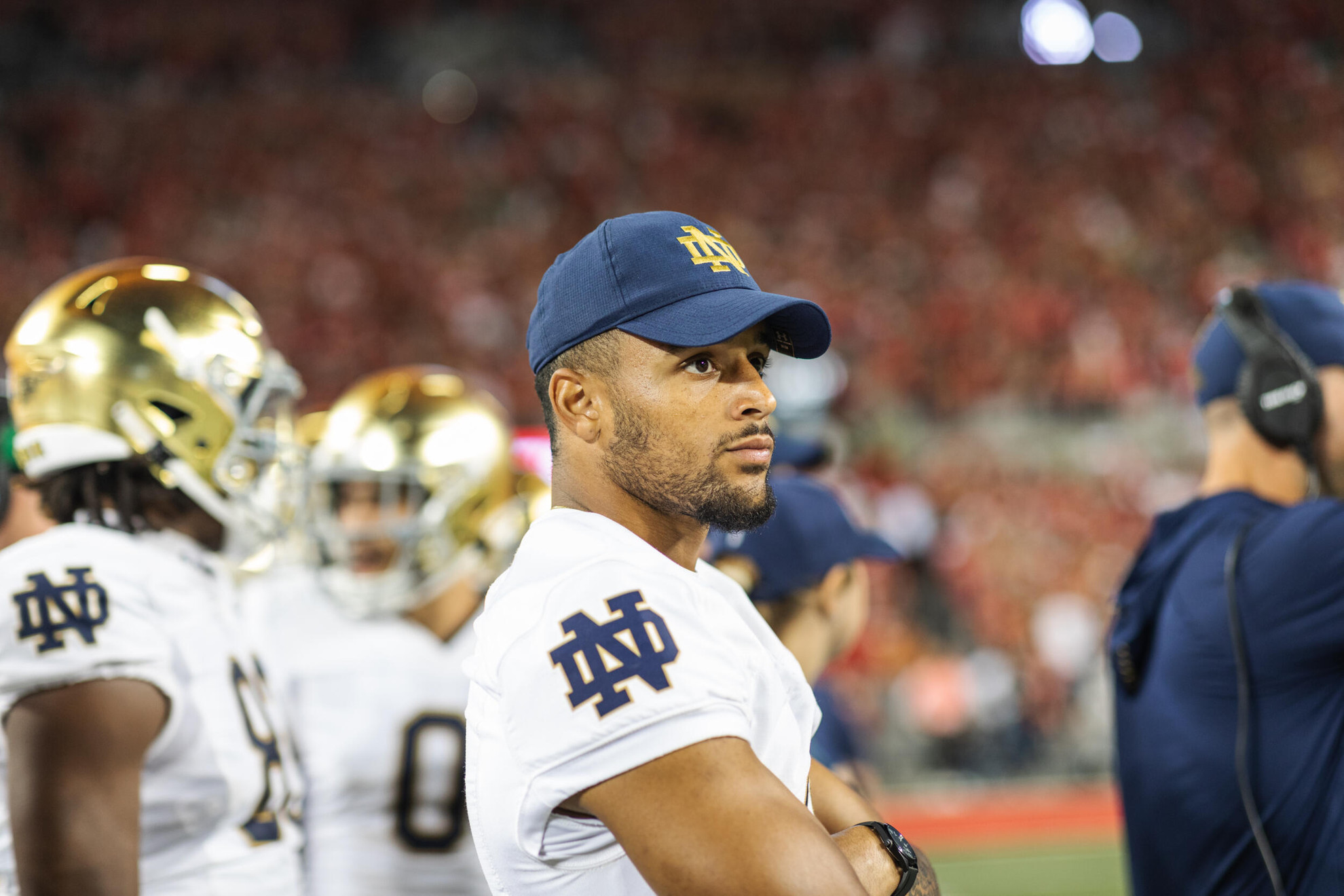
“It’s hard to miss Bo [on the field], but he’s a great captain,” Foskey, like Bauer and Davis a team captain, said. “He leads the special teams in the right way. He was coaching up everybody, especially me, to get a punt block. He gets a couple of punt blocks every year. We’re going back and forth trying to get punt blocks, but I think I’m ahead right now.”
As players recruited by a different head coach and an almost entirely different assistant coaching staff, Bauer and Davis could have perhaps checked out in this season of transition and unfortunate adversity for Notre Dame football.
Instead, Freeman noted, they – along with Tyler Buchner, seated in the coaches’ box on game days with the offensive staff – have maintained valuable roles not reflected in a box score.
Members of Freeman’s Irish football family will invest into the program or divest from the program.
“I don’t care if you redshirt, I don’t care if you are not going to play, if you’re injured, what value do you bring to our football program?,” Freeman asked. “If you don’t have value, why are you here? Again, if you’re waiting for your turn, then watch the game at home. We have to have value. For some guys, that might be cheering on your team. That might be a set of eyes. Tyler Buchner, that’s a set of eyes for the quarterback, for Coach (Tommy) Rees.
“But some of those guys that aren’t playing and aren’t going in the game, you got to have value. That can be being an energy-provider, something, you can’t just be at the game watching. You can go in the stands or go watch the game from home. That is big for our program.”
Davis’s ongoing investment into Notre Dame football, amazingly, might be only his second-best example.
His sheer stick-to-itiveness has echoed as loud as that 53-yard scorching of the Clemson defense that set up Davis’s overtime-forcing touchdown two plays later in what became a landmark, 47-40 double-overtime win that propelled the Irish to their first-ever Atlantic Coast Conference championship.
“The biggest thing is that I like finishing stuff that I started, which is probably why I stuck around here; one of the biggest reasons,” Davis said. “I felt like when my injury happened, I offered more to the team than just my athletic ability. I didn’t want to drop that responsibility and be an outsider or an outcast or isolate myself or go back home.
“I thought it would be good for me to be around the guys; they give to me just as I give to them. They keep me in high spirits, and it keeps me motivated and my mind clear when I’m around them.”
Davis, too, has found himself immersed in Notre Dame football. In Freeman’s Notre Dame football program.
“It’s very important, because when there’s a change in coaches, it’s certain places that there tends to be a shift in culture,” he said. “But one thing we’re big on here is the culture and bringing in the right people. If I can be a model for that, it’s something that makes me warm in the heart.
“I really appreciate the role, and I’ve accepted it. As a freshman, that’s what I wanted to do. I wanted to be a captain. You look up to the guys with that ‘C’ on their chest and the lineage of those who have worn it. I take a lot of pride in it.”
Freeman, much as ‘The Rock’ used to crow in professional wrestling, has slammed home his “Know-your-role” mantra.
“Everyone has value, and what their role is, is important,” Freeman said. “Everybody’s role is important. I don’t care who you are in our football program. You accomplishing your role is as important as me accomplishing mine. I think they have to understand that. Everybody has to understand it. We as coaches have to be clear with what we believe each person’s role is.
“You’re injured Eli (Raridon), here’s your role. Coach (Gerad) Parker, let’s get with him [and say] ‘Here’s your role. Accomplish your job.’ It shows that everybody has value. We’ve got to make sure we’re clear and define that and then we hold the players accountable.”
For Davis, accountability and the role go hand-in-hand.