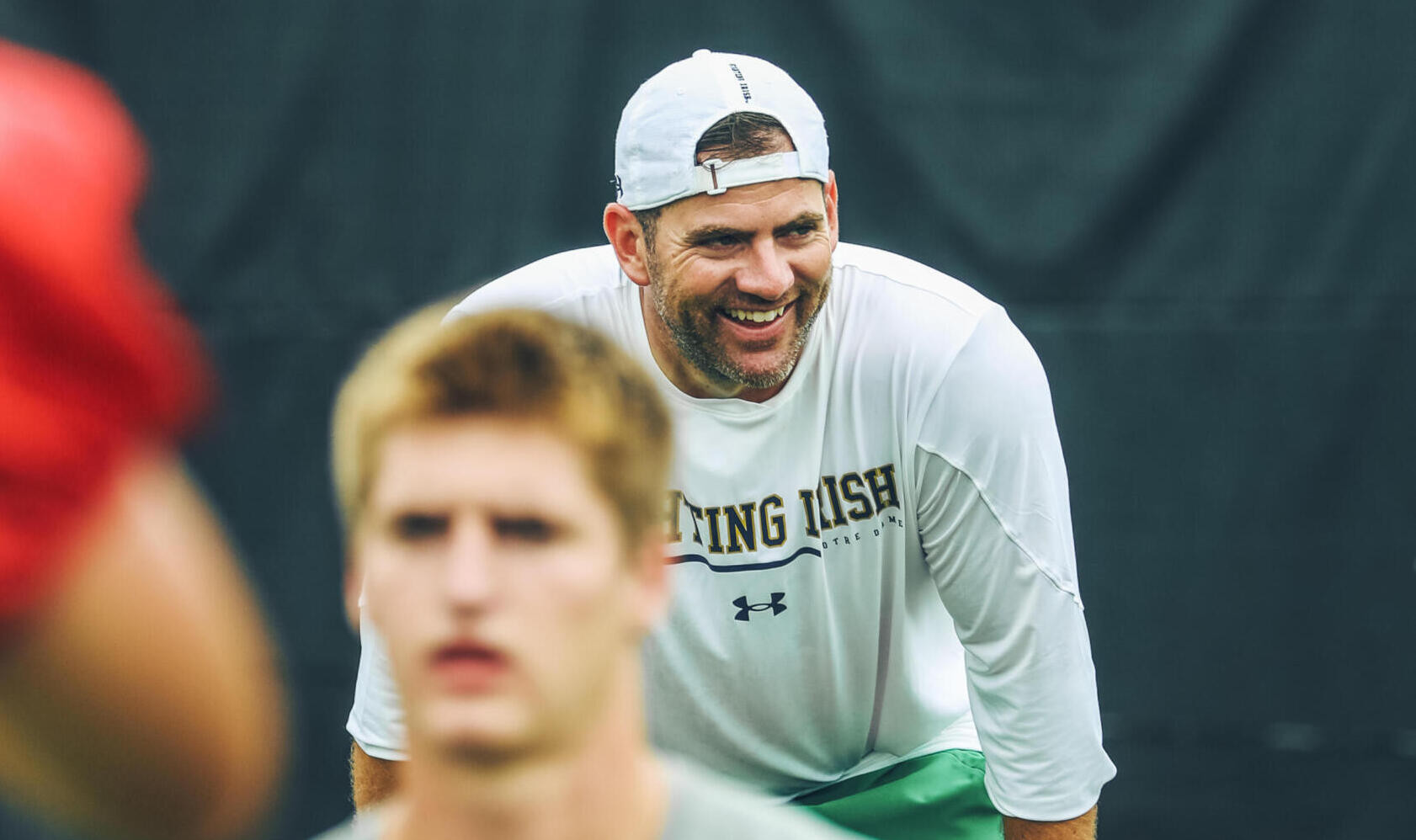
Even nearly 15 years hence, Simpson sees in the drill a visual of Parker the person – newly minted Notre Dame offensive coordinator.
“It’s a physical drill, you’ve got to be tough,” he says. “There were different things, chin-shots, basically just taking a running drive-block from the receiver. You have to partner up, the guys would have to cross their arms and take the brunt of his partner just coming at him, bending at the ankles, knees, taking the hits and the guy shooting his hands into the hairline of his hat (helmet). For those receivers to absorb that contact, that’s not always the most physical group, but Gerad played receiver and was coached by a physical coach, and I just thought that was neat.”
Simpson’s faith in Parker includes entrusting the former University of Kentucky wideout with the keys and responsibility of handling operations for UTM’s filming of practices.
Geep Wade, similarly at a fledgling stage of his career more than a decade ago at UTM, remembers toiling through various other chores with absolutely no bearing on a game plan or its execution.
A young coach’s rite of passage.
“We painted offices, cleaned out locker rooms, pressure-washed stadiums,” says Wade, Georgia Tech’s offensive line coach and owning experience as a colleague to Parker at both UTM and Marshall. “We had a nice grass practice field there at Martin, and we’d change from the game field to practice field to work, and at that level, you don’t get many angles to film (practice) and you don’t have a built-in tower. We all had little duties like that. Gerad was in charge of video, and we were all young and naïve to the pressure of the game.
“We just had fun, worked our tails off. Got there early, worked late.”
Parker’s 18 years of coaching, including his start at small, 300-student Raceland-Worthington High School in Kentucky, bring him to his standing as offensive coordinator of the Fighting Irish, a team in present form eyeing a 2023 College Football Playoff berth and a program whose historical placement in the sport carries few equals.
None of this is lost on Parker, who during his introductory press conference Monday intones an earnest, everyman-yearning to success because, of course, he’s a competitor but likewise because he knows he’s in Notre Dame’s top offensive chair through a series of events that in football parlance stem from off-script moments.
Parker doesn’t care. He’s continuing forward in all facets – admittedly dreaming along the way – since the departure of previous play-caller Tommy Rees.
“You transition to what is the direction and the times and the conversations you get to have with Marcus,” says Parker, native of Louisa, Kentucky, the state’s eastern-most community before the confluence of the Big Sandy, Levisa Fork and Tug Fork rivers gives way to West Virginia. “’Where are you headed with it? How can I help?’ And I mean that, and he knew I’m in it.
“Then there’s a little piece where you let your mind drift because I’ve always been ambitious. We all are, and ambition has a price. But also put a plan together. If my job were to maybe help with how we’re going to construct certain interviews, and I want to provide help that way. But then when my mind would drift late at night when I was wondering, I put notes in my phone.”
Notes still present in the iPhone of Parker, a father of four with wife, Kandi, a Kentucky High School Athletic Association Hall of Fame inductee for her dominant prep basketball career.
“I would constantly have things that I would put in, and if those things were just things that I kept in my phone for next year or the year after the year after, so be it,” says Parker, who in addition to Freeman considers former Tennessee national championship-winning offensive coordinator Randy Sanders and the one-time Notre Dame wideouts coach Phillips, also a former Kentucky head coach, along with Simpson among his key mentors. “My phone is decorated with those (notes), and when you put those in, you always stay prepared because what a sin it would have been if Marcus Freeman calls my number to do an interview and I’m not ready.
“That’s how I feel. That’s how I felt about it and what a shame had I not been ready for this opportunity.”