
It was the first time Notre Dame ever won a game with a field goal as time expired.
For those that were in attendance, it was one of the most thrilling wins of the rough and tumble Joe Kuharich era.
For college football, it was a rules book reckoning that involved legendary names like Hesburgh, Joyce, Krause, Crisler and Neyland.
It was the early 1960s version of this year’s Michigan vs. Western Michigan game, or the 1990 fifth-down controversy between Colorado and Missouri, or maybe even Cal - Stanford with ‘the band on the field!’
This is the story of the 1961 Notre Dame - Syracuse football game. The Kick. The Chaos. The Commitment.
PART I - THE KICK
The 1961 season started out well for Notre Dame after the 2-8 debacle of 1960. The Irish beat Oklahoma at home in the first game, slipped by Purdue in West Lafayette, 22-20, then demolished Southern Cal 30-0 in Notre Dame Stadium. Notre Dame rose up the ranks to No. 6 in the country, but suffered successive losses to No. 1 Michigan State, Northwestern and Navy which sent the Irish tumbling out of the rankings before a victory over Pittsburgh meant the team would meet No. 10 Syracuse with a 4-3 record.
The Syracuse season started differently from the Irish, as The Orange lost two of their first five games with future Heisman Trophy winning running back Ernie Davis. Three straight dominating victories over Holy Cross, Pittsburgh and Colgate brought the Orange back to the top 10 in the country and the program eyed the possibility of an Orange Bowl berth as ‘the top team in the east’ with a victory at Notre Dame.
The teams met in The House That Rockne Built on Saturday, November 18, 1961. It was a chilly and snowy day in South Bend. The Irish held a 7-0 lead at halftime on the strength of a Frank Budka 41-yard touchdown pass to Angelo Dabeiro. In an unusual twist, the Notre Dame student body created a human tunnel for the team to take the field after the halftime break to provide their squad with more momentum going into the game’s final 30 minutes.
The game picked up intensity during the third quarter. Syracuse accidentally touched a punt to give Notre Dame the ball at the 25-yard and Budka connected with Les Traver for a touchdown pass from that spot. Trailing by two scores, Syracuse went for it on fourth-and-one close to midfield and scored when quarterback Dave Sarette found John Mackey (yes, the same one whose name is on the best tight end in college football trophy today) for a 57-yard score. Syracuse went for two and cut the lead to 14-8.
At some point in the late third quarter, Sarette was injured on a big hit from Budka and back up Bob Lelli came in to throw a two-yard touchdown pass with 10:35 remaining in the game. The Orange had rallied to take a 15-14 lead.
The visitors had every opportunity to seal the game in the last five minutes. Budka threw an interception with 5:05 remaining. Lelli, whose inexperience to work the clock would show itself in the game’s final moments, was forced out of bounds on fourth down and Notre Dame got the ball back with 1:50 left. Another Budka tipped-pass interception came on the next play and it seemed Notre Dame was doomed. Syracuse could not run out the clock, however, after throwing an incomplete pass on third down and Lelli getting shoved out of bounds on fourth down again.
Notre Dame got the ball back with just 17 seconds left at its own 30-yard line.
Budka scrambled to the Syracuse 49 with 0:08 left. The Irish signalcaller then found George Sefick for a 10-yard catch to inch into field goal range with 0:03 left. Joe ‘The Toe’ Perkowski came in to attempt an incomprehensible 56-yard field goal.
Notre Dame had never made a 50-yard field goal (this was still the time when the kicker took one step and ‘toed’ the ball straight on) and would not make a 50-yarder until the 1976 season.
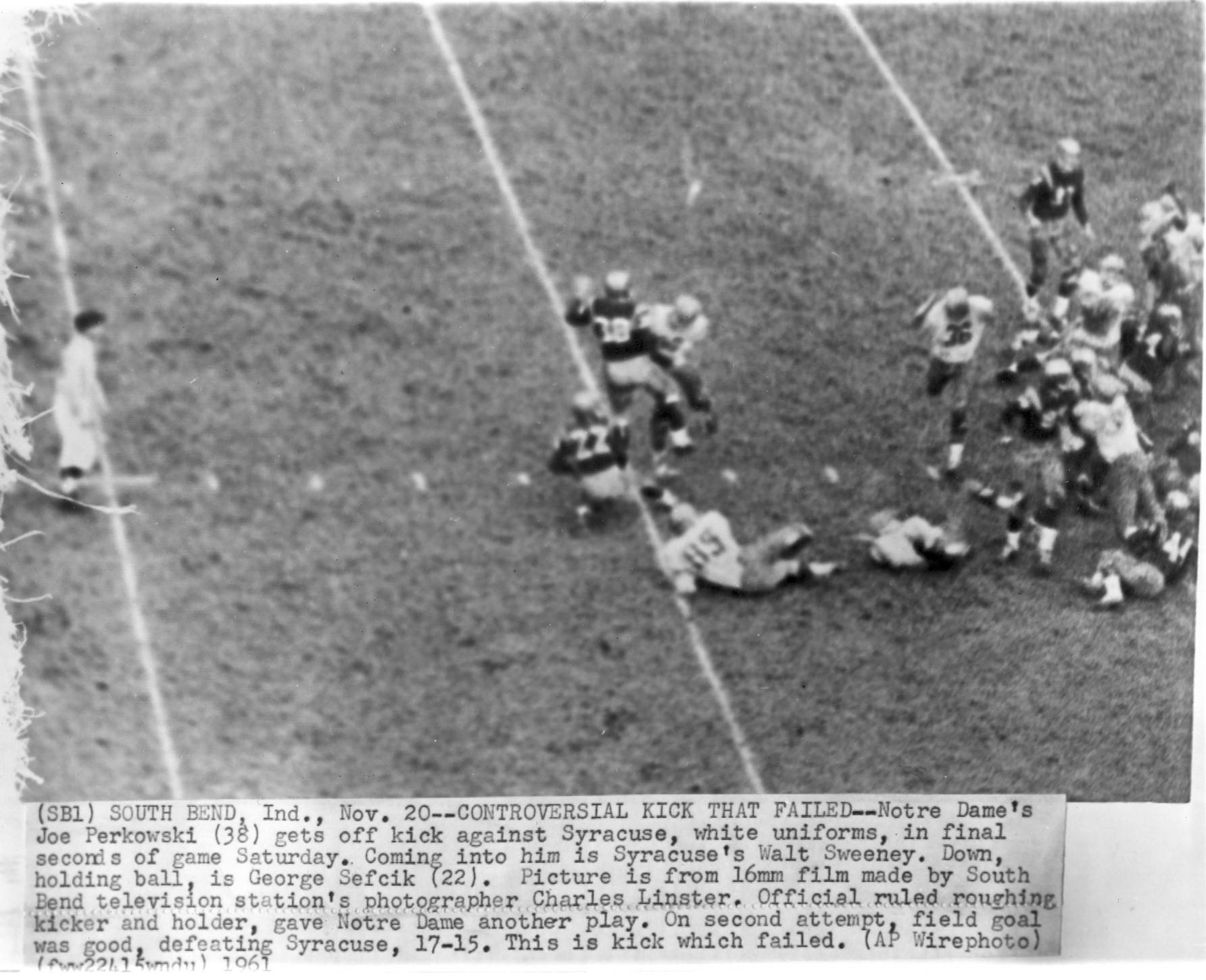
Perkowski missed the kick badly. It fell short of the end zone. After Perkowski kicked the ball, Syracuse’s Walt Sweeney hammered him, sending him sprawling into the holder Sefick. The head lineman official, F.G. ‘Gus’ Skibbie, whose name would soon be known across the country, came in and threw a penalty flag.
I will let the late South Bend Tribune legend Joe Doyle provide the scene, as he wrote it the next day.
From the east sidelines, head linesman F. G. Skibbie waved his hands frantically. Then he threw his red flag. A left side lineman for Syracuse tried a "Texas-type" tackle on Sefcik, the placement holder.
Jubilant Syracuse players and fans raced onto the field. Skibbie and associates waved them back, because the rules of football state that a foul called on a play that ends a period stops the clock and permits one more play even if there is no time remaining.
Referee Tony Skover marched off the 15-yard penalty for a personal foul. Then Perkowski tried again. The ball, snapped from the 24½ and held on the 31, soared high and true. From the moment it left Perko's toe, it looked like a three-point arrow cutting an indelible crease in the heart of a great Syracuse team. The ball carried into the stands and some fan now has a souvenir of the most fantastic Notre Dame victory of all time.
It was pure pandemonium and euphoria on the field. This was the first game-winning field goal as time expired (or, more accurately, had expired) in school history. The students rushed the field to celebrate and even attempted to tear down the goal posts. Robert Schmuhl, Walter H. Annenberg-Edmund P. Joyce Professor Emeritus of American Studies and Journalism at Notre Dame, who taught me in my time on campus, was at the game and told me last week that “the Notre Dame band came onto the field and played The Victory March. The people in the stands kept yelling, ‘Play it again! Play it again! Which the band did.”
James C. Mullen in the Chicago Sun-Times described it as “wild, crazy, unbelievable. It couldn’t happen and yet it did.” The official who threw the flag, Gus Skibbie said that “I have never seen anything close to it and I never hope to.” Skibbie also remarked about the foul as well. “It was a rather stupid thing to do,” he said. “It was very unlikely he (Perkowski) would have made the kick from so far out.”
Doyle described Syracuse head coach Ben Schwartzwalder as ‘stunned’ after the game and that his reaction to the call was “I can’t say anything about the penalty. He (Skibbie) called it. I don’t know.”
The Syracuse papers focused on the late flag, thrown ‘at least 10 seconds’ after the first kick had been taken.