







Nov. 2, 2006
By Katie Stuhldreher
Did you know that legendary Irish head football coach Knute Rockne was knighted by the king of Norway? That he enjoyed drama as a student at Notre Dame and even wore elaborate wigs to play female parts in campus productions? That he almost left Notre Dame mid-way through his career for an offer to coach at USC? That he was born in the same 12 month period that Notre Dame played its first football game?
These and many other interesting details of Knute Rockne’s life are currently featured in a new exhibit in the Northern Indiana Center for History: Rockne–Crossing the Last Chalk Line.
Knute Rockne coached the Fighting Irish in the 1920s and 1930s, perfecting the forward pass and leading the Irish and legendary Four Horsemen to their first national championship in 1924. To date, Rockne holds the most impressive win-loss record of any professional or college football coach with 105 wins, 12 losses, and 5 ties. He had a lifetime winning percentage of .881 and produced 20 first team All-Americans. “The Center for History is proud to work in partnership with the University of Notre Dame on this exhibit about Notre Dame’s legendary Knute Rockne. Coach Rockne’s story is pure Americana, and will interest anyone who gets excited at the snap of the ball and the roar of the crowd,” says Randy Ray, the Center’s executive director. The exhibit, which runs until January of 2007, displays the personal items of Rockne’s never before openly available to the public.
Marilyn Thompson, director of marketing, remarks “The exhibit includes significant artifacts of Knute Rockne’s that have never been shown before. All of these items are borrowed from private collectors or Notre Dame archives. This exhibit is actually very large and we’re very excited about it.”
The exhibit takes the viewer through Rockne’s history, starting with the news of his tragic death in an airplane crash on his way to California in 1931. The first room of the exhibit houses newspaper headlines announcing the revered coach’s death and telegrams Rockne sent to his wife shortly before boarding the flight.
An emotional story is told of how Rockne’s two oldest sons’ train was delayed, causing them to miss what would have been a short visit with their father before he boarded the fateful flight.
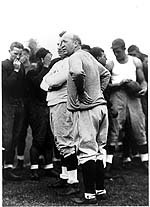
Here Rockne watches drills during an Irish practice. Rockne’s sweatshirt, whistle, clipboard and a movie camera he used to film practices are on view in the exhibit. It is the first time since his death in 1931 that they have been shown together. (Photo courtesy of Notre Dame Archives).
|
 |
Rockne’s wristwatch which he wore the day of the crash in Kansas is displayed in the exhibit. The hands of the watch were stopped at exactly 11:15, the moment the plane crashed.
Details from Rockne’s funeral at Sacred Heart Basilica at Notre Dame are also part of the exhibit and various theories about the cause of the crash are also explored. Some witnesses said the plane crashed due to inclement weather, but other people offered conspiracy theories about an Al Capone plot to down the plane, not realizing Rockne was on board.
In the second large hall of the exhibit, Rockne’s early years in Norway and his time as a Notre Dame student are explored. The exhibit features one of Rockne’s chemistry notebooks. He was an exemplary student and worked closely with Father Nieuwland, who helped invent synthetic rubber. Rockne was also active in drama on campus, and viewers can see a photograph of young Rockne wearing a wig with long braids to play a role in a production.
“He was repeatedly a scintillating success in the roles of shop-worn females,” joked Father John Cavanaugh (Notre Dame’s ninth president).
The oldest football artifact in the nation also is featured in this room –the program from the first Notre Dame football game, played in 1888 against Michigan. The program reflects how new the game was at the time in America; it includes a detailed explanation of the rules of the game and how points were awarded. Photographs depict Notre Dame’s first team playing with makeshift field goals and no protective padding.
“We’re so pleased to have this program here,” said Thompson. “This is really huge.”
Rockne’s career as an assistant and later head coach of the Irish is illustrated in many game notes, as well as his sweatshirt, whistle, clipboard, and a camera he used to film games.
“This is the first time all of these things are together under one roof. It’s really an amazing experience,” Thompson says.
The exhibit also houses an original copy of Grantland Rice’s story in the New York Herald Tribune in 1924 originally dubbing Rockne’s star players Harry Stuhldreher, Elmer Layden, Don Miller, and Jim Crowley the “Four Horsemen.”
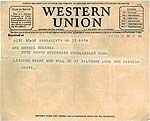
Just before boarding his fateful flight to California, Knute Rockne sent this telegram to his wife, Bonnie. Only a few hours later, she received one from Transcontinental and Western Airlines, informing her of her husbands’ death. It is the only existing notification of Rockne’s death.
|
|
All of the items in the exhibit are on loan from private collectors, including John Augustine and Andrew W. Nickle.
The third room of the exhibit shows Rockne’s role as a salesman for Studebaker Corporation and houses a vintage model of the Rockne automobile produced by Studebaker shortly after Rockne’s death.
Unique to his time, he was an endorser of football equipment. This section of the exhibit displays football pants, helmets, and cleats endorsed by Rockne.
“Now we see Tiger Woods swinging his club, wearing Nikes, and think nothing of it. But at this time period, it’s really just amazing to think of things like that,” says Thompson.
An inside look at the production of the film “Knute Rockne: All American,” which featured Hollywood stars like Ronald Reagan runs at the exhibit. The film’s premier was held in South Bend, and one of the original banners for the film’s debut hangs in the exhibit.
A final tribute to Rockne’s immortal legacy, showing various memorials to the great coach around the country, ends the exhibit.
“The exhibit is named `Crossing the Last Chalk Line’ because Bernard Miller, a 15-year-old boy who won a national essay contest about Notre Dame referenced a locker room speech Rockne gave using that line. We thought it worked on a lot of levels, showing what a dedicated coach he was, never giving up,” Thompson says.
Throughout the football season, the Northern Indiana Center for History welcomes a lecture series every Thursday and Sunday of home and away football weekends. Lecture topics include Rockne’s legacy, Notre Dame Heisman trophy winners, and the Notre Dame–Army rivalry. Admission is free for members and students, $8 for adults and $6.50 for seniors.
“We’ve had such a great turnout so far,” said Thompson. “We’ve had people come into the exhibit and then come back again to see it another time.”
The exhibit will remain open until January 7, 2007. The Northern Indiana Center of History is located at 808 West Washington and is open from 10am to 5pm Monday to Saturday and noon to 5pm on Sunday. For more information visit www.centerforhistory.org.