







Oct. 5, 2006
|
 |
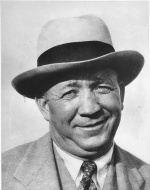
Knute Rockne died in a tragic accident 75 years ago on March 31, 1931. In commemoration, the Northern Indiana Center for History has opened the most extensive exhibit ever developed on the legendary football coach. “Rockne: Crossing The Last Chalk Line” explores the Rockne story, including his childhood, his days as a student, player and coach at Notre Dame, the events surrounding his death, and the legend that developed and remains to this day. The compelling exhibit showcases many artifacts that have never before been shown publicly. It will be on view through January 2007.
| Click for Larger Image
|
|
As visitors enter Rockne, they are transported in time to the tragic spring day when Rockne’s airplane crashed in a Kansas field, killing all eight aboard. On loan from Andrew W. Nickle is the watch Rockne wore, the shattered crystal showing the exact time of impact. Nearby is the newspaper whose headline exclaims, “ROCKNE KILLED IN AIR CRASH.” Also shown is the telegram Rockne sent to his wife, Bonnie, just before he boarded the aircraft. It reads: “Leaving right now…Love and Kisses=Knute.” Another one, received only a few hours later by Mrs. Rockne from the airlines company begins, “We regret it becomes our painful duty to notify you of the death of Mr. Knute Rockne who was a passenger on our westbound plane…”
Leaving the area that captures the solemn funeral, visitors discover Rockne as a youth, as a Notre Dame student, and in his first years as assistant football coach at Notre Dame. Some may be surprised to learn of the striking coincidence whereby the famous coach was born within the same 12-month period that Notre Dame played its first football game.
| Click for Larger Image
|
|
Much of the 3,500-square-foot gallery focuses on Rockne’s career, and visitors are reminded of the extraordinary way he skyrocketed the Notre Dame football program to national fame. Leading five undefeated football teams, Rockne produced 20 first-team All-Americans and had a lifetime winning percentage of .881, still the highest ever of any college or professional football coach. Rockne’s sweater and whistle, on loan from the University of Notre Dame Archives, serve as a testament to his coaching record of 105 wins, 12 losses and 5 ties, which remains the benchmark of football.
Stories unfold of George Gipp and other the players who became famous playing for Rockne. Visitors can view an original banner from the 1924 National Championship team, on loan from Andrew W. Nickle, along with the famous October 19, 1924, New York Herald Tribune newspaper article by Grantland Rice in which he dubbed Notre Dame’s Crowley, Layden, Miller and Stuhldreyer as the “Four Horsemen.”
In yet another area of the exhibit, Rockne as a promoter for Wilson Sporting Goods and other products, Studebaker sales motivator, and coaching camp entrepreneur comes to life. Visitors are introduced to footballs and other products he endorsed, can hear speeches he delivered and see advertisements for his football training centers, including his first one, at Culver Military Academy.
The legend that began to develop almost immediately following his death^and still exists today^is explored in the final area of the exhibit. All the excitement of Saturday afternoon football game can be experienced through the original 1929 drawing by the Osborn Engineering Company of Notre Dame Stadium, “The House That Rock Built.” Visitors can view a vintage 1932 Studebaker Rockne, on loan from John Augustine, and the story of the Hollywood film is told through the vast number of documentaries and movies about him, including Knute Rockne^All-American, a 1940 film which had its national premiere in South Bend.
|
|
Rockne: Crossing the Last Chalk Line not only chronicles this extraordinary life, but also serves to inspire and electrify visitors as they gain new perspectives of the famous coach, just as 15-year-old Bernard J. Miller was motivated in late 1931. With Rockne having died only a few months earlier, the youngster entered a nationwide essay contest launched by a Hollywood production company to promote its new film, The Spirit of Notre Dame. In his composition, “What the Spirit of Notre Dame and Knute Rockne Mean to Me,” young Miller wrote of a pep talk Rockne had given to his football team, in which the coach exclaimed, “…and don,t stop until you cross the last chalk line.” It is from this poignant theme that the exhibit takes its name. Visitors will want to absorb every detail, every photograph, and every artifact of this football coach who will never be forgotten.
Tony Roberts, former voice of Notre Dame football, brings to life the exhibit through an accompanying audio tour that he narrates. Through headsets, museum visitors can listen to Roberts as he provides supplemental commentary about many of the Rockne artifacts on view. There is a small charge for the audio tour. The Center for History offers cutting-edge museum technology to the community by providing the opportunity to hear the audio tour online at www.centerforhistory.org. Individuals can also download the audio tour to an iPod.
In addition, on every Thursday evening and Sunday afternoon of a Notre Dame football weekend, the Center for History is presenting lectures and films that relate to Rockne and Notre Dame football.
The Northern Indiana Center for History is located at 808 West Washington. The museum is open 10 a.m. to 5 p.m. Monday – Saturday, and noon to 5 p.m. on Sunday. Admission is $8 for adults, $6.50 for seniors 60+, $5 for youth 6-17 or in college, and free for members. A campus admission, which includes entrance to the adjacent Studebaker National Museum, is $12.
For information, contact the Center for History at (574) 235-9664 or visit www.centerforhistory.org