







Feb. 24, 2005
The University of Notre Dame official athletics site, www.und.com , continues its tribute today to the school’s celebration of 100 Seasons of Basketball. Spanning the entirety of the college basketball season, www.und.com, will update this section of the site every weekday 100 times in an effort to highlight Notre Dame’s 100th Basketball Season in 2004-05.
The updates will change between trivia questions, quick bios from Notre Dame’s all-century team, various “On this date in Notre Dame Basketball” elements and more.
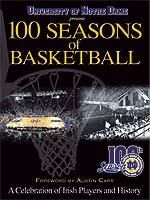
Also available this season is the book 100 Seasons of Basketball, produced by the University of Notre Dame Sports Information Office and Notre Dame Sports Properties. The book is available exclusively through the Notre Dame Bookstore (call 800-647-4641 or to go www.ndcatalog.com).
#79 (Friday, Feb. 25, 2005)
All-Collegiate Basketball Team
After the original Fieldhouse burned down in 1900, Notre Dame was without a varsity basketball team for eight years. A group of students, not officially representing the University, did play during the 1907 Christmas vacation.
Calling themselves the All-Collegiate Basket Ball Team, they compiled a 5-3 record against some of the top college and independent teams in the region and went on to become the nucleus of the rejuvenated varsity in 1908.
Also – on this date in Notre Dame Basketball history (plus dates that fall over the upcoming weekend) –
Feb. 25, 1952 – With star Joe Bertrand injured, standout Leroy Leslie fouled out and three players academically ineligible, football player Johnny Lattner (the 1956 Heisman Trophy winner), an emergency replacement, is inserted with 26 seconds left in overtime and hits the game-winning basket with nine seconds remaining as the Irish defeat NYU, 75-74, in Madison Square Garden.
Feb. 25, 1993 – The longest game (three overtimes) in the Joyce Center’s history ends with a 80-76 loss to Duquesne. Sophomore Billy Taylor plays all 55 minutes for the Irish.
Feb. 26, 1978 – Freshman Kelly Tripuka scored all 15 of his points in the second half and sophomore Bill Hanzlik puts the clamps on All-American Butch Lee as Notre Dame rallies from a 17-point deficit to defeat #1 Marquette, 65-59, in the ACC.
Feb. 27, 1980 – In perhaps the greatest game ever played in the ACC, #14 Notre Dame defeats 25-0 and #1 DePaul in double overtime, 76-74. Two Tracy Jackson free throws force the first overtime, a Rich Branning jumper sends it into a second and Orlando Woolridge’s two free throws with 19 seconds left give the Irish the final margin of victory. Kelly Tripuka leads the team effort with 28 points.
NEXT UPDATE:
#80 (Monday, Feb. 28, 2005)
Legend of the Hardwood – Ron Reed
#78 (Thursday, Feb. 24, 2005)
Guiding Lights – John Dee
John Dee became the head coach at Notre Dame in 1964 and took the Irish to the NCAA Tournament in his first season. He collected an overall record of 116-80 (.592) in his seven years, including consecutive 20-win seasons in each of his last four years, the first 20-win seasons in Notre Dame history.
Dee attended Notre Dame from 1944-46, earning a spot on the Irish basketball and football teams. Dee is the only player in Notre Dame football history to play in just one career game and start that contest (vs. Georgia Tech in 1944). In basketball, Dee was a two-year letterwinner and played in the 1944-45 and 1945-46 seasons, when the team had a combined record of 32-9. Dee averaged over 10.0 points per game. He received his degree from Loyola of Chicago in philosophy and history in 1947.
Following graduation, he coached four years in Chicago high schools and attended Notre Dame Law School during the summers. In 1951-52, Dee was an assistant coach at Notre Dame for John Jordan and received his law degree that spring.
At age 28, he was named the head coach at Alabama and became the youngest head coach in NCAA basketball at that time. In four seasons, he compiled a record of 68-25, including an SEC title in 1956. From 1956-62, he coached the D-C Truckers in Denver, winning the NIBL title once and finishing second three times.
Dee led his Irish teams to four appearances in the NCAA Championship and one NIT trip. Every student-athlete that Dee recruited to Notre Dame and Alabama received his undergraduate degree. Dee resigned from coaching after the 1970-71 season to practice law in Denver and served as auditor of that city. He passed away on April 24, 1999.
Also – on this date in Notre Dame Basketball history –
Feb. 24, 1897 – Football coach Frank Hering molds a basketball “varsity team” with the top players in three halls (Brownson, Carroll and Sorin) and trounces Fort Wayne YMCA, 26-11, in the old Carroll Hall gymnasium.
Feb. 24, 2001 – In Mike Brey’s first season, Notre Dame clinches its first BIG EAST championship – the West Division – with an 85-61 rout of Virginia Tech on the road. It is Notre Dame’s 11th league victory en route to an 11-5 conference finish. The Irish were 35-53 in conference play their previous five seasons, and never better than 8-8.
#77 (Wednesday, Feb. 23, 2005)
They Said It
Reflections on Notre Dame Basketball by some of its all-time greats…
Adrian Dantley, 1974-76
“Notre Dame basketball offered me the opportunity to fulfill a dream. As a child, I dreamed of playing on a Notre Dame team. I was thrilled to realize that dream.
Notre Dame’s global popularity and exposure had an impact upon my career. Playing at Notre Dame allowed me to display my basketball skills before a national audience. As a result, pro scouts and fans became well aware of my abilities. In fact, on many occasions, I have been recognized as a Notre Dame alumnus instead of as an NBA player.
My basketball and educational experiences at Notre Dame provided positive lessons. The people I met and the variety of experiences I had at Notre Dame helped to shape my perspectives on life. I rely on those perspectives in the rearing of my children.”
The second-highest scorer in Notre Dame history, Dantley poured in 2,223 points in his career, averaging 25.8 per game. He also nabbed 9.8 rebounds per game (843 total), won a gold medal on the 1976 Summer Olympic team and, upon his retirement from the NBA, was ranked ninth in the league in all-time scoring (23,177 points) and fifth in free throws made (6,832).
Also – on this date in Notre Dame Basketball history –
Feb. 23, 1970 – Due to academically ineligible players and several others who miss the team bus, Notre Dame travels to Butler with seven players. The Bulldogs attempt to outrun the Irish but fail as Austin Carr scored 50 and Collis Jones adds 40 in the 121-114 shootout. It is the most points tallied by two teams in a Notre Dame game.
#76 (Tuesday, Feb. 22, 2005)
Fantasy Fives – the 1960s
As part of Notre Dame Basketball’s 100 year anniversary and the book 100 Seasons of Notre Dame Basketball, a team called the `Fantasy Five’ – the best players of a given decade, was developed. Here is a look at the top five players of the 1960s.
Backcourt:
Ron Reed (1962-65)
Larry Sheffield (1962-65)
Frontcourt:
Bob Arnzen (1966-69)
Walt Sahm (1962-65)
Bob Whitmore (1966-69)
The Reed-Sahm-Sheffield trip was the first of three Notre Dame classes to have three players tally more than 1,000 points – and the only one to do it in just three seasons. Sahm is the all-time career rebounds-per-game leader (16.9) and Reed holds the single-season mark (17.7). Sheffield’s 18.7 career scoring average is 10th on the all-time Irish chart.
In 2004, classmates Arnzen and Whitmore still ranked 10h and 11th in points scored and both averaged double-doubles as three-year starters. Arnzen averaged 20.3 points and 11.5 rebounds, while Whitmore posted 18.8 and 12.4 figures, respectively.
Also – on this date in Notre Dame Basketball history –
Feb. 22, 1981 – For the third time in 360 days, Digger Phelps’ Irish defeat the #1 team in the nation, this time in Chicago’s Rosemont Horizon. Orlando Woolridge’s turnaround 16-footer off a long rebound connects as time expires to lift Notre Dame past the Ralph Sampson-led Virginia Cavaliers, 57-56. “It’s spooky,” said Phelps of the Irish success against #1 teams.
Feb. 22, 1986 – Three months after Notre Dame’s ignominious 58-7 loss at Miami (Fla.) in Gerry Faust’s final game, Digger Phelps’ Irish punish the Hurricanes on their home floor, 126-73 – two points more than Miami’s victory margin in football.
Feb. 22, 1992 – After an inauspicious 1-5 start under first-year head coach John MacLeod, the peaking Irish rout #2 UCLA, 84-71, in the fourth of five victories against ranked foes.
#75 (Monday, Feb. 21, 2005)
Legend of the Hardwood – John Paxson
It is safe to say that John Paxson (1979-83) is one of the best outside shooters in Notre Dame Basketball history (shooting 53.5 percent as a junior and 53.3 percent as a senior back up the statement). It is also safe to say that Paxson would have scored close to 1,700 points if the three point shot would have been implemented during his time at Notre Dame (Paxson finished with 1,366 points).
Paxson bided his time both at Notre Dame and in the NBA. He apprenticed under Rich Branning in 1979 before stepping in as a starter his freshman season. He labored in San Antonio for a few years before finding a spot with the Chicago Bulls, winning three championships by draining open jumpers provided by the defensive pressure on Michael Jordan.
Paxson ended his career at Notre Dame with a modest 12.2 points per game average, but he also put up 17.7 ppg his senior season. While his statistics are not eye-popping, Paxson defined the early 80s of basketball at Notre Dame.
He is currently the general manager of the NBA’s Chicago Bulls.
Previous 100 Years in 100 Days updates:
Week Eight (#50-#54) ND – UCLA ’74