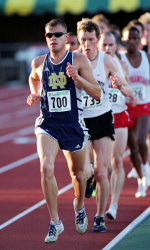
 Shay was in the front of an early pack during the 2001 NCAA 10K – but he soon pushed the pace and went on to win by a 20-second margin (photo by NCAA photos).
“If I was going to win, that’s where I wanted to do it,” recalled Shay, who even had a series of articles about Prefontaine taped to his bedroom walls.
Shay, who entered the 2001 NCAA 10-K race as the #4 seed, made a bold move early in that elite race. After sitting back through the first lap, he decided to take the initiative by picking up the pace.
“I told myself that it was going to be a 10-K race from the start,” Shay later said. “Anybody who wanted to go out slow, this wasn’t going to be the race for them. I’ve learned from experience not to be content to sit back and take it slow. So I kind of forced the issue.”
By the time Shay reached the halfway mark, the race had become a two-man battle between himself and Link. With three laps to go, Shay’s lead was so large that only a fall could prevent his historic championship-winning performance. But top seed Keith Kelly of Providence College, the reigning NCAA cross country champion, had developed a reputation for being a strong closer who could erase seemingly insurmountable leads
“I kept waiting to hear his footsteps, but they never came,” said Shay, who finished a whopping 46 seconds ahead of the favored Kelly.
Shay left his own footsteps on the sport of marathon racing, after making the rare jump from being a premier collegiate distance runner to becoming one of the nation’s top competitors at the grueling 26-mile distance.
“Ryan was one of the first guys who came straight out of college and said, `I want to run a great marathon.’ Some who have gone from college running to the marathon did not excel on the track during their college career like Ryan did,” says Watson, who currently serves as a member of the cross country and track-and-field coaching staffs at Notre Dame.
“During Ryan’s first season as a professional, he won the U.S. Marathon. For a newcomer to make that quick of a jump from college to being an elite marathoner was revolutionary. Now people are doing it more regularly, including Ryan Hall [who concluded his career at Stanford in 2005 and won Saturday’s 2007 Olympic marathon qualifier]. If not for Ryan Shay, I don’t think it would have been as easy for others to make the jump from running 10-Ks to marathons.”
Hall – who never had run a marathon before April of this year – followed Shay’s lead in making the quick transition to the longer distance. Hall’s eighth-place finish at that first marathon (in London, versus an elite field) produced the fastest marathon debut ever by an American.
Shay and Hall recently had been training partners near Hall’s college stomping grounds in Woodside, Calif. (near Palo Alto). But the Shay-Hall connection has yet another layer, as their wives – both Olympic hopefuls in the 10,000 meters – were teammates at Stanford and are close friends. Just four months ago, Sara (Bei) Hall served as a bridesmaid at Ryan and Alicia Shay’s wedding in Jackson Hole, Wyo. – and the two couples went on a “fun run” through Central Park last Friday, the day before the Olympic trials.

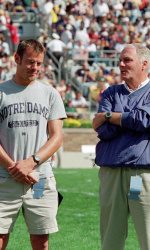
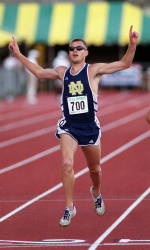 Ryan Shay’s first-place finish in the 2001 NCAA 10,000-meter race represented Notre Dame’s first national championship in an outdoor track-and-field event in nearly 50 years (photo by NCAA photos).
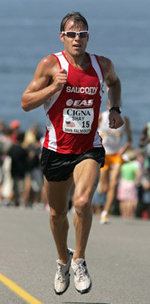 Shay’s quick transition from being an elite college distance runner to emering as one of the nation’s top young marathoners made him a revolutionary in the world of competititve running.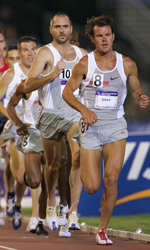
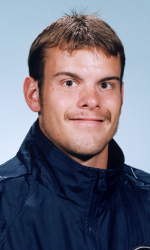 Shay recently had married former Stanford standout Alicia Craig, a 2008 Olympic hopeful in the 10,000 meters.
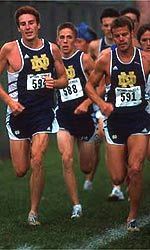 Roommates Luke Watson (left) and Ryan Shay (right) were a formidable pair on the cross country trails during their Notre Dame careers (photo by Matt Cashore).
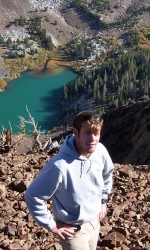 Shay’s adventurous spirit extended to exploring the back roads during his time in Mammoth Springs, Calif.
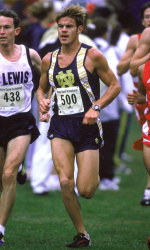 Shay was a fierce competitor on the cross country trails whose strong devotion to the team produced a gutsy performance that helped the Irish win the 2001 BIG EAST title (photo by Matt Cashore).
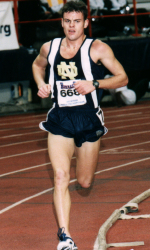 Shay came to Notre Dame as one of the middle children in a family of eight distance-running siblings.
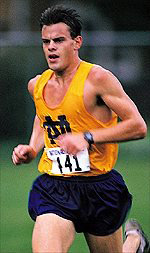 Shay posted his first of nine All-America honors with a 12th-place finish at the 1999 NCAA cross country meet (photo by Matt Cashore).
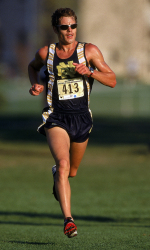 Shay – who often appeared at ease in his races, despite the brisk pace – will be remembered for more than simply his running dominance and competitive drive.