
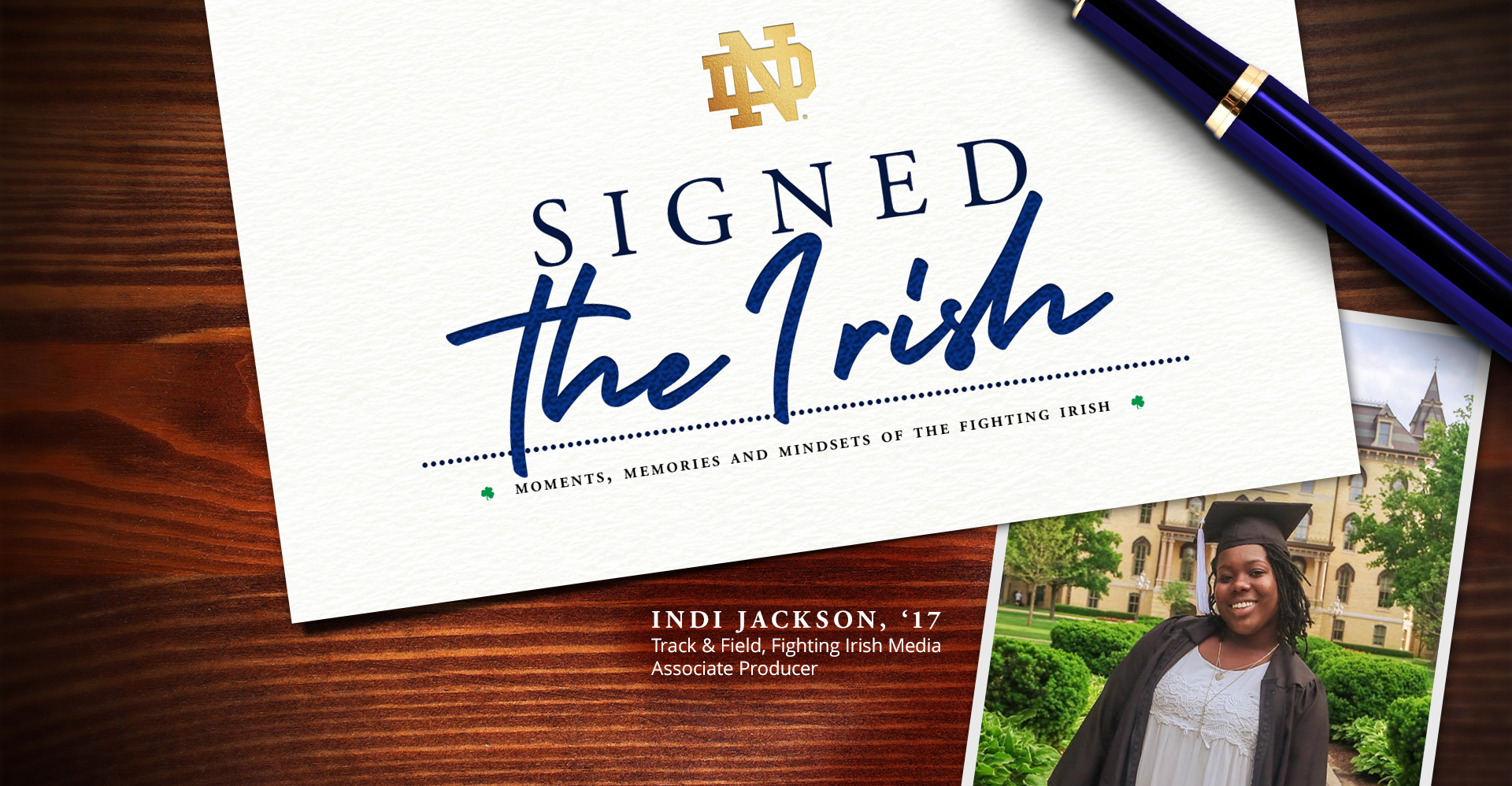
Indi Jackson is a 2017 graduate of the University of Notre Dame. Formerly a student-athlete with Track & Field, Jackson now works in Fighting Irish Media as an associate producer, feature.
This week, Fighting Irish Media premieres a brand-new podcast, Brave Voices at ND, which will feature important and fruitful conversations about the issues of race in and around our campus. Although releasing during heightened media attention around social injustice, the need for this podcast has been years in the making.
As a former student and current employee of the university, there have been multiple times when I wished I had an outlet, a place to share my story and hear others, to know that I wasn’t alone.
With this podcast, we’re aiming to give our student-athletes and other members of our community a chance to share in the healing, and give listeners the opportunity to engage in the urgency of these accounts.That being said, at times we will have fun and laugh. This podcast should be a space to come and learn, not a source of intimidation. We’re all trying to get better – so let’s do it together, and let’s enjoy it.
I am grateful for Notre Dame. The opportunities I have earned here and the experiences that I have been afforded as part of this community will forever stay with me, but so will the pain I felt along the way. As students, we are taught that each member of this Notre Dame family has a responsibility to leave it better than we found it. I want this community to do and be better. We all get stronger as we grow, but the strength of the black community should not be an excuse to persist with damaging behavior.
With that being said, before you tune into Episode 1, I hope you start with my story. Let’s call this section:
Episode 0, Indi Jackson: The Times I Knew We Needed This Podcast
The first time I knew this community needed a form of cultural competency began in 2013. It was the year I left my home in Michigan and arrived at the university. During the first weeks of school, campus was buzzing from the controversy the year before where fried chicken bones were discovered in the Department of Africana Studies’ mailboxes. Displeased and disgusted, I thought nothing of it until I attended my first college party. Seconds after crossing the threshold, my friends and I were met with, “Who invited the hoodrats?” The first of many racial slurs I would hear around campus, and the first time I questioned my place as a member of the community.
My sophomore year, recovering from an ACL tear, a guest speaker received an invitation from a university club to visit campus. The Black Students Association proposed a silent protest to oppose this speaker’s racially-offensive slurs; within the next week, an email from the sponsoring club’s president was intercepted and shared with the black student body. In it, the club president used phrases such as “welfare recipient in his step-mother’s basement who hasn’t seen the light of day since his trip to the 2008 polling station,” and “NDream illegal alien love fest.” He went on to graduate soon thereafter. Time No. 2 I wish we had this space to address this behavior.
Years Three, Four and Five all had their fair share of racially-infused incidents, but also personal successes. I broke the indoor shot put school record, I worked for NFL Films and I completed a documentary that received many awards. However, I heard and saw the N-word on multiple occasions, watched guests who actively spoke out against the black experience be invited to campus and endured plenty of personal microaggressions about my identity as a black woman daily.
I had endured moments growing up that made me feel as though I was not good enough, I didn’t belong and my life as a black woman did not matter. Entering Notre Dame, I had hoped this would not be the case, but the cycle of permanent stains and painful memories continued, and I see the cycle growing in our world. Too many times throughout my experience, my teammates, teachers, coaches and friends cut me daily with silence simply because they were not educated on our differing experiences.